Friday, August 27, 2010

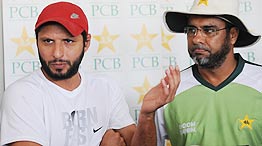
Waqar, Afridi disagree on Malik's omission


Karachi: Trouble is brewing in the Pakistan cricket team as coach Waqar Younis is reportedly at loggerheads with ODI and Twenty20 captain Shahid Afridi and chief selector Mohsin Khan over the omission of Shoaib Malik and Umar Amin from the squad for the one-day series in England.
Reliable sources told PTI that Waqar wanted Malik and Amin to be retained in the one-day squad and had disagreed with Mohsin and Afridi when they consulted him on phone while finalising the squad on Wednesday.
"Waqar felt that Pakistan needed Malik's experience for the one-day series and he would get back into form soon. While he also believes that Umar Amin is a great talent for the future and must be given confidence," one source said.
Malik played in three Tests in England and failed in them while Amin too came a cropper. Both were dropped from the one-day squad by the selectors owing to poor form.
Afridi also said it was time for Pakistan to start preparing a nucleus of players for the 2011 World Cup.
The source said the chief selector had also questioned the need to have rookie left-arm spinner Reza Hasan for the Test matches when Pakistan had been playing the experienced spinner Abdul Rehman.
Incidentally, Pakistan's former coach Mudassar Nazar has also come out in favor of having Malik in the team despite the all-rounder's recent poor form.
Mudassar told a cricket website that Malik's omission came as a surprise to him.
"Shoaib Malik's omission has been rather surprising and is not justified. He has been a good one day player and should have been in the squad," he said.

Cricket cannot afford meaningless games

A topsy-turvy, irrelevant and largely unnecessary tournament lurches towards a final. It has been characterised not by outstanding cricket but by wildly fluctuating performances. If a team vanquishes its opponent by 200 runs one day and loses by 105 a week later, which is the better team? One-sided games are not good contests and there hasn't been a good contest so far in Sri Lanka.

It makes you wonder if teams would have played differently if this were a World Cup, where every match counted towards something, where a defeat strengthened resolve for it meant a greater peak had been installed in the way. I have long argued that increasingly, audiences are only concerned with whether or not the home team is playing. It now seems that we are progressing towards audiences asking us whether or not a game is relevant. Sri Lanka could not produce crowds for a home game against India. It is an alarming, and peculiarly welcome sign.

Cricket cannot afford to throw up meaningless games before its benefactors, which is what spectators and television audiences are. If you want their money you must offer them a spectacle and while sometimes the promise may not be fulfilled, even the football world cup threw up many duds including the final, the intent has to come shining through. In any case, spotting cricket on a telecast these days grows increasingly difficult.

Players, however, cannot afford to treat a contest as just another game. They are fulfilling a dream that few can see realised. And the opposition is quick to spot laziness and arrogance anyway. Like an author, a cricketer signs his name on every innings he bats or bowls in; indeed for every cricket ball that challenges him on the field. It is a mandate he must feel privileged to uphold. Over the last couple of weeks I am not sure I got that impression every time.

India must also be concerned by the inconsistency of the younger players. Across professions, consistency is a direct product of work ethic. The greats were defined by their consistency because they were wedded to work ethic. No oddball gambler ever achieved greatness. Some, like Shane Warne, suggest occasionally that they might be mavericks but when his leg break didn't obey the bowler's command, he worked harder than anybody else on it. Sometimes I feel the lessons from the legends are misplaced in satiated youthfulness.

And so, in the four games played at Dambulla, India's batting seemed to revert to the old movie formula; one hero, one supporting actor and no one else of any consequence really. This was the opportunity for challengers to Tendulkar, Gambhir, Harbhajan and Zaheer to make a statement. They haven't yet. If anything has been gained it is that Sehwag is doing his one-day career some justice. With every innings he seems to rise above his generation and earn for himself a more exalted place.

Meanwhile the IPL, and the BCCI, lurches from one controversy to another. Clearly no organisation is run by monks, and who knows there might be political undercurrents in monasteries as well, but the quality of governance must remain non-negotiable. With disciplinary issues smothering cricketing ones, the IPL must wake up to the blow its image is taking. Whether or not media allegations are true, the damage in the eyes of the public has to be addressed. An outstanding brand cannot lapse into somnolence; cannot be defined by committees and a bureaucracy.

IPL needs refurbishing

Outside of India's private sector, which has many islands of excellence amidst other less agreeable ones, brand India has rarely been characterised by outstanding governance. For every success story in software, telecom and manufacturing, we have the Commonwealth Games to portray us as pathetic, bumbling organisers. The IPL promised to be different, to be a genuine global sports brand born and nurtured in India. It can still be but its mind seems to be elsewhere, caught up in committees and personal conflict. Like India's young middle order, it needs some refurbishing.

Tuesday, August 3, 2010

Mohd Asif in Malayalam Movie

Shooting of the movie, titled 'Mazhavillinnattamvare' (till the tip of the rainbow) produced by Sharjah-based businessman M. Mukundan  under the banner Valluvankadavu Recreations is scheduled to begin in North Kerala in September.

The movie is also the directorial debut of famous lyricist Kaithapram Damodaran Namboodiri., who has penned hundreds of songs.

"Asif is now busy playing cricket in England. He will be free by September to begin shooting in Kannur in north Kerala," Kaithapram says.

"The film starts with Asif coming to a cricket camp in Kannur as a coach. When he travels from Lahore to Kerala, he has a personal mission too. The film will progress through his journey to his goal",added Kaithapram.

There would be five songs and a ghazal. The songs would be rendered by top Indian singers like K J Yesudas, Udit Narayan, Sankar Mahadevan, K S Chitra, Deepankuran and Shreya Ghoshal.

The film is being produced by a Sharjah-based entrepreneur M Mukundan, who hails from Kannur, under the banner of 'Valluvankadavu Recreations'.

Thursday, July 29, 2010

Morgan leads recovery after Aamer makes inroads

Tea England 190 for 4 (Morgan 44*, Collingwood 27*) v Pakistan
Pakistan made significant inroads on the opening day of the first Test at Trent Bridge, but Eoin Morgan and Paul Collingwood led an England rally as they reached tea on 190 for 4. Mohammad Aamer continued the form that had caused Australia so many problems with three wickets while the other went to Mohammad Asif as the hosts stumbled either side of lunch. Kevin Pietersen and Jonathan Trott fell in the space of four balls but the innings was put back on track as Morgan counter-attacked with a punchy display.
It was a typically mixed performance from Pakistan both with the ball and in the field. Kamran Akmal had a difficult time behind the stumps as he dropped a sitter off Andrew Strauss early in the first session and the support bowling for Aamer and Asif was distinctly lacking in quality.
There was also plenty of action for the UDRS as four reviews were called for in the first two sessions. Two of those were during Kevin Pietersen's painful 29-ball innings as Pakistan twice challenged not-out decisions. Asif was the bowler on both occasions, firstly with an lbw appeal which replays showed was only clipping the bails then when he thought Pietersen had edged to the wicketkeeper but the noise, expertly noticed by Asoka de Silva, had been bat clipping pad.
Pietersen, though, never settled and looked woefully short of form in his first innings for nearly a month and there was no doubt about his eventual dismissal when Asif nipped a ball back which took the inside edge into the stumps. It was another wonderful piece of bowling from an intelligent operator.
England's problems were compounded in the next over when Jonathan Trott, who had been reprieved by the UDRS when he had 13 after being given lbw to Danish Kaneria despite an inside edge, padded up to an inswinger from Aamer and this time Trott's request for a review couldn't save him.
At 118 for 4, Morgan was in the position to prove he could haul his team out of trouble in five-day as well as one-day cricket. He had an early alarm when he edged Aamer and Akmal - possibly out of sheer delight of thinking he'd caught one - claimed the dismissal but even with the naked eye it hadn't appeared to carry and replays confirmed the ball grazed the turf.
After that scare Morgan settled and battled hard to see off the main threat of the pace bowlers. His reward was to face two spinners, Kaneria and Shoaib Malik, who were used in tandem by Salman Butt as he rested his quicks towards the end of the session. He drove Malik powerfully through the covers and had the confidence to unfurl a reverse sweep off Kaneria whose lack of control was a problem for Butt.
Collingwood offered typically fighting support and broke the post-lunch shackles when he dispatched consecutive short balls from the struggling Umar Gul through the covers. By tea the fifth-wicket stand was worth 72 and it was Pakistan needing to regain control.
Strauss had looked in good form during the morning session although had huge stroke of luck when Akmal added another awful drop to a sizeable collection of keeping horrors. Akmal had been tidy during the recent series against Australia and there was a sense of disbelief that such an easy chance had gone down but he remains an unconvincing gloveman.
The mistake appeared to shake Pakistan who looked a little flat and when Aamer fired a ball so far down the leg side that it barely hit the cut strip heads threatened to drop. However, with the following ball Aamer hit the perfect line to Cook who was squared up on off stump and edged low to first slip. Trott then did well to keep out his first delivery as Aamer produced a well-directed yorker and England were relieved when his opening six-over spell came to end.
Strauss and Trott progressed comfortably as they added 51 for the second wicket but 10 minutes before the break Butt recalled Aamer for his second spell. With his fourth ball he found Strauss's top edge as the England captain's eyes lit up at a hint of width. It sent Pakistan into lunch in decent spirits and their mood improved further shortly after the resumption, but by tea momentum was beginning to shift again in what has already been a compelling contest.

India ahead as run-fest continues

India 669 for 9 (Tendulkar 203, Raina 120) lead Sri Lanka 642 for 4 dec by 27 runs
Normal service resumed on the fourth day with bat dominating ball on a placid pitch, after the Sri Lankan spinners had injected life into the Test on the third. India ensured a draw was inevitable, as they overhauled Sri Lanka's first-innings score, with Sachin Tendulkar and Suresh Raina adding to an exhaustive list of milestones achieved in this game. Tendulkar eased to his fifth double-century while Raina became the first Indian batsman since Virender Sehwag in 2001 to score a Test century on debut.
As Tendulkar and Raina took India past the follow-on target, the proceedings evoked memories of the dull draws these two teams played out during the 1990s. With spread-out fields, a slow pitch and conditions discriminating against the bowlers, Sri Lanka's triple strike on the third morning proved an aberration.
That was evident in the positive approach adopted by Tendulkar and Raina at the outset on the fourth day. Tendulkar, who had been more sparing in his treatment of fuller deliveries amid pressure on day three, resumed his innings with a cover drive off Suraj Randiv. The seamers, while troubling Tendulkar occasionally with well-directed bouncers, were dealt with more harshly. Dammika Prasad, after striking Tendulkar on the helmet, was cracked for three fours through point; Dilhara Fernando, who induced Tendulkar to play an ill-executed upper cut - he had Tendulkar dropped off the same shot the previous day - was at the receiving end of his trademark straight drive.
Tendulkar shrugged off a couple of close shaves against Randiv - he padded up to deliveries that straightened but was saved by the bounce - by sweeping effectively against the turn and brought up his double with a paddle down to fine leg. 
Raina showed few signs of nerves in his maiden Test appearance, looking confident early in his innings. He didn't hesitate to step out against the spinners on the third day and began in a similar vein on the fourth, lofting Randiv over long-off. Unlike Tendulkar, Raina played the pitched-up deliveries with more comfort throughout his knock. He played his favourite slog-sweep to dispatch Randiv over midwicket, and brought up his ton with a drive through mid off. The celebration began the moment he connected; he clenched his fists, ran to the other end and soaked in the applause for an achievement that opened up India's options in their Test middle order. He was beaten by a Mendis legbreak shortly after lunch and spooned an easy catch to short midwicket but only after India had reached safety.
The batsmen that followed had plenty of time to adjust to variations in pace as well as frequent changes in length, and runs flowed at a healthy pace. This was on display in the manner that MS Dhoni settled in, stepping out to Mendis on just his fifth ball and pulling Prasad for consecutive boundaries. The spinners were heaved and slogged and Dhoni notched up another fifty.
Tillakaratne Dilshan salvaged some pride with a couple of quick wickets. Tendulkar was caught off an inside edge onto the pads, and Harbhajan Singh gifted a catch to midwicket. The resistance, however, continued with Dhoni and Abhimanyu Mithun occupying the crease for 21.4 overs before Dilshan struck again to snare the Indian captain.
Kumar Sangakkara kept three close-in catchers for much of the day, hoping the extra bounce would yield something. The seamers had a slip against Tendulkar, an additional leg slip for Raina, as well as a silly point for Dhoni when he was new to the crease. Perhaps Mendis could have come on much earlier than at the stroke of lunch. But their hopes were thwarted by a determined effort from Tendulkar, Raina and Dhoni, who have set up a third Test finale at the P Sara Stadium.

Saturday, July 24, 2010

Pakistan prevail in thrilling finale

Pakistan's long, long wait for a Test victory over Australia finally came to an end amid scenes of excruciating tension on the fourth morning at Headingley, as a simple equation of 40 runs for victory with seven wickets still standing was made to look as complex as the proof to Fermat's Last Theorem. They eventually crept home with three men still standing, but their collective nerves in tatters, as Umar Gul launched the winning shot through the covers with the scores already level.
The margin of victory looked more comfortable than it felt, and that's putting it mildly. The eventual difference between the sides was the wicketkeeper, Kamran Akmal, whose 13 from 26 balls was as close as Pakistan came to a composed fourth-day performance. That said, had Akmal been given out caught in the gully with five runs still required, who knows what miracles might have transpired. Mike Hussey's low scoop was turned down by the TV umpire, but after Mohammad Aamer had edged another four to balance the books, Akmal slammed another chance which Hussey this time plucked to his left.
The morning had begun amid scenes of raucous optimism from the noisy knots of Pakistan fans in the Western Stand - lured by five pound tickets and the prospect of a chance to witness history - and there was an early moment of poignancy as well, as Rudi Koertzen was given a guard of honour to commemorate the final day of his 108-Test umpiring career. 
But as soon as the focus returned to the centre of the field, Australia resumed their attack with the same vigour that had hauled them back into contention in the final moments of the third evening's play. Doug Bollinger, who had jolted Pakistan with two wickets in seven balls, made it three in 17 as the overnight anchor, Azhar Ali, feathered a length delivery through to Tim Paine, only moments after spanking a full toss through the covers to bring up his maiden Test half-century.
At 146 for 4, with a tantalising 34 still needed for victory and Australia's fielders cranking up the chatter, the stage could hardly have been less ideal for the impetuous Umar Akmal, a man who likes nothing better than to blaze away with impunity. He edged Ben Hilfenhaus for a streaky four through third slip, a shot accompanied by a roar of relief from the stands, but one over later, he was gone as well, via a flat-footed poke to a regulation outswinger.
With Bollinger bounding in with the unstoppable intent of a latter-day Merv Hughes, appeals and alarms were two-a-penny. Kamran Akmal survived consecutive appeals for caught behind and lbw - both rightly turned down by Koertzen - before Shoaib Malik was dropped one over later by a diving Michael Clarke at second slip. He couldn't make his luck count, however, as Marcus North at extra cover clung onto a full-blooded drive off Hilfenhaus, to leave Pakistan on the ropes at 161 for 6, with Aamer's appearance at No. 8 scarcely helping to settle the nerves.
Akmal's response was two priceless fours in five balls - the first a touch streaky as he snicked an outswinger away through third man, the second more emphatic as he got up onto his toes to punch a drive through extra cover. With 13 consecutive Test victories over Pakistan, including their corker at Sydney in January, Australia's belief did not waver at any stage of the morning, but in the final analysis, they were unable to make amends for their 88-all-out debacle on the first day.

Tendulkar denies blood-in-book report

New Delhi: Sachin Tendulkar has denied a report that his blood will be used in a special pictorial "celebration" book on the career of the Indian cricket legend.
The mammoth book slated to appear in February is designed to be the "ultimate tribute to a living sporting legend" and "the definitive work on his life and career", publishers Kraken said.
The 37-year-old Tendulkar, who is in Sri Lanka playing a Test series, denied reports which appeared last week in British newspaper The Guardian that his blood would used on the book's signature page.
"There is no truth in my blood being part of the book," Tendulkar told The Times of India in comments published on Saturday.
Kraken chief executive Karl Fowler was quoted by the British broadsheet as saying 10 copies of the book would be printed using Tendulkar's blood.
Fowler, who had been earlier cited as saying Sachin's blood would be "mixed into the paper pulp so it's a red resin" told the Times of India that his comments had been "misunderstood."
"The Opus will not carry any blood as mentioned in the several articles/TV reports that have appeared over the past few days," The Times quoted Fowler as saying.
"I believe my thoughts on this matter have been misunderstood," the publisher added.
News reports say around 1,000 Opus copies, each numbered and personally signed, will go on sale at 2,000 to 3,000 dollars.
Each of the 852 pages are 50 centimetres (20 inches) square and edged in gold leaf. The publication weighs 37 kilograms (82 pounds) and contains around 1,500 images and more than 300,000 words.
Tendulkar is the first cricketer to be given the Opus treatment. Previous works have been published on Ferrari, Manchester United, Diego Maradona, Michael Jackson and the Burj Khalifa.

Malinga rested, Mendis likely to replace Muralitharan

Sri Lanka fast bowler Lasith Malinga, who helped bowl his side to a 10-wicket victory over India in the first Test on Thursday, has been rested on medical advice for the second Test that starts on Monday.
Malinga was rested on the advice of team physiotherapist Tommy Simsek after the bowler complained of stiffness in his right knee, chairman of selectors Aravinda de Silva said.
The 26-year-old, who only returned to the test arena at Galle after having last played a test match in Dec. 2007 because of an injury to the knee, took five for 50 in India's second innings that helped his side to a 1-0 lead in the three-match series.
"We have to be cautious with Malinga. He was not feeling quite fit to go through a five-day Test. He complained of stiffness in his knee," said De Silva.
Malinga will be replaced by Dilhara Fernando.
Ajantha Mendis who took six for 67 in a three-day game against India but was overlooked for the first test, was named in the 16-man squad and is likely to take the now retired Muttiah Muralitharan's position.
Muralitharan retired after he took his 800th test wicket with his final delivery at Galle.
Former captain Mahela Jayawardene was named as Kumar Sangakkara's vice-captain to replace Muralitharan.
"We want Mahela who has a good cricket brain to be part of the decision-making in the middle," said De Silva.
Sri Lanka squad: Kumar Sangakkara (captain), Tillakaratne Dilshan, Tharanga Paranavitana, Mahela Jayawardene, Thilan Samaraweera, Angelo Mathews, Prasanna Jayawardene, Ajantha Mendis, Dilhara Fernando, Chanaka Welegedara, Suraj Randiv, Rangana Herath, Thilina Kandamby, Dammika Prasad, Lahiru Thirimanne, Nuwan Pradeep.

Sunday, July 18, 2010

Sangakkara and Paranavitana punish India

The Test is only a day old but already it appears as though it's Sri Lanka's game to lose. As expected, the lambs were led to slaughter. The Indian bowling attack defined mediocrity and Sri Lanka bossed it around in style to reach a strong position by the end of the opening day in Galle. Kumar Sangakkara and Tharanga Paranavitana sealed well-compiled tons as the hosts galloped towards gaining complete control before rains brought an early end to the day's play.
No Test hundred is easy. Especially if it's scored against a team ranked No. 1 in the world. However, this was one of the easier hundreds Sangakkara has scored against a top-ranked team. A maiden hundred, though, is never easy irrespective of the opposition and Paranavitana played splendidly to get to his. His celebration was befitting of the landmark: He screamed in delight, pumped his fists, jumped in joy, and ran almost all the way to the boundary.
What stood out was the ease with which Paranavitana and Sangakkara progressed. It appeared as though they were having a net session. India's weak bowling attack was further handicapped by Harbhajan Singh's ailment. He hobbled away during the second session and, though he returned to bowl later, was still suffering from the after effects of the injury and illness that threatened his presence in the team. He hardly looked his best and once again disappeared into the pavilion in the final session.
Without Harbhajan in his element, India's attack lacked bite, inspiration and skill, which was reflected in the lines bowled. Pragyan Ojha pinged the middle-and-leg line with a backward short leg and short leg in place. Often, he slipped the ball outside leg. While Paranavitana swept and worked him behind square leg, Sangakkara backed away to cut from middle stump. Never did it seem that he was taking any undue risk.
Harbhajan bowled farther outside off and hardly got the two left-hand batsmen to drive. He had a short cover and a short extra cover in place but the length and line was never right for the drive. The part-timer Virender Sehwag eventually produced mistakes from the batsmen. Sangakkara, on 65, edged a square drive but MS Dhoni couldn't catch a straightforward chance and Paranavitana edged an attempted cut but Yuvraj Singh couldn't reach it despite a dive at backward point.
For the main part, the batsmen sparkled with pretty stroke play. Sangakkara's best shot was an on-the-up punch to the straight boundary off Ishant Sharma, who was poor in his first couple of spells. Sangakkara repeatedly tucked and punched Ishant through the on side and used his crease to cut and drive the spinners. He sashayed down the track to crash Ojha to the long-on boundary and swept and cut Harbhajan. Early in his innings, Sangakkara played a couple of expansive shots - one which flew just past short extra cover and the other which vanished over the slips - but he quickly settled down. The trademark Sangakkara hits were on display: the square drive on bent knee, the cover-drive hit with a high front elbow, and the precisely placed cuts and the occasional dash down the track.
His partner Paranavitana had started with two edged boundaries in Ishant's first over but quickly tightened his game. He rarely chased the ball, he rarely tried to play an expansive shot and he rarely looked in trouble. There was a punchy drive through extra cover against Ishant and an off-driven boundary in the same over during the first session. There was also a moment of apprehension, when he got a leading edge against Harbhajan in the last over before lunch, but Gautam Gambhir couldn't react quickly enough at silly point to take it. Paranavitana continued to make merry after the break: He flicked and off drove Mithun, slog swept and straight drove Ojha, and rotated the strike with dabs and nudges.
Sangakkara had chosen to bat after overnight rain delayed the start and left the pitch damp in Galle. Though Sri Lanka lost Tillakaratne Dilshan, who gloved an attempted pull against Mithun, they hardly broke a sweat thereafter.
The manner of Sangakkara's dismissal captured the spirit of the day. The ball was a long hop from Sehwag and Sangakkara pulled it straight to Sachin Tendulkar at deep midwicket. It seemed the only way the Indians were going to buy a wicket and it was aptly gifted to Sehwag, the best Indian spinner on view.
There were couple of other moments that indicated perhaps the course of the Test. The first was when Ishant got a delivery to kick up from short of a length with a puff of dust from the pitch. A few overs later, Ojha drifted one in from round the stumps, pitched the ball on leg and middle and got it to spin across Mahela Jayawardene's bat. Muttiah Muralitharan, eight wickets short of 800, wouldn't have missed either sign

ebook